Colt Python Review: The New Blued Python Is a Better Shooter | Larry Vickers

by Larry Vickers
Vickers Tactical, retired US Army 1st SFOD- Delta combat veteran
The Colt Python: From Iconic Beauty to Reliable Range Beast
I’ve never been much of a revolver guy. That’s no secret. My wheelgun education came almost entirely from one man: Ken Hackathorn. Ken is a world-famous 1911 guru, but he’s also a serious revolver enthusiast who forgot more about sixguns than most people will ever know. When Ken talked revolvers, I listened.
He laid it out plainly for me. The gold standard for U.S.-made premium revolvers is the pre-war Smith & Wesson Registered Magnum. The most durable revolver ever built is probably the Manurhin MR73. And the most attractive revolver of its type ever made? That’s the Colt Python, hands down. But in the same breath, Ken would tell you the original Python simply wasn’t built for serious shooting. It was a looker, not a workhorse. Put any real volume of .357 Magnum through one and you’d start seeing timing issues, wear, and problems that beautiful guns aren’t supposed to have.
That all changed when Colt reintroduced the Python a few years ago. They went back to the drawing board and did the engineering and metallurgy work necessary to turn it into a better, more durable shooter. By all accounts, they succeeded.
The Challenges of Bringing Back the Blued Python
Colt offered the new Python in both stainless and blued versions, and the blued guns presented some real manufacturing hurdles.
First, the blued finish. Any imperfections in the metal prep or polishing show up far more dramatically on a deep blued gun than they do on the factory stainless finish. Both versions go through the same tightly controlled process: a ceramic slurry tumbling operation in what is essentially an oversized vibratory bowl (think the kind you polish brass in, but on a much larger and more precise scale). Special polymer fixtures keep the parts from banging into each other during tumbling. It’s a modern, repeatable method that delivers consistent results, but bluing is simply less forgiving of any surface irregularities.
The second challenge was the steel itself. The carbon steel alloy for the blued Python had to be carefully developed and extensively tested for durability and compatibility with the bluing process. Bluing is an oxidation process that requires iron in the steel—something that’s present in carbon steel but absent in the 17-4 stainless used for the other variants. That 17-4 alloy is actually stronger overall, but it can’t be traditionally blued. Dialing in the right carbon steel blend while maintaining the strength and shootability Colt wanted was no small feat. Those were really the two big technical challenges for the blued Python and Anaconda variations.
Why the New Python Is Simply Better for Shooting
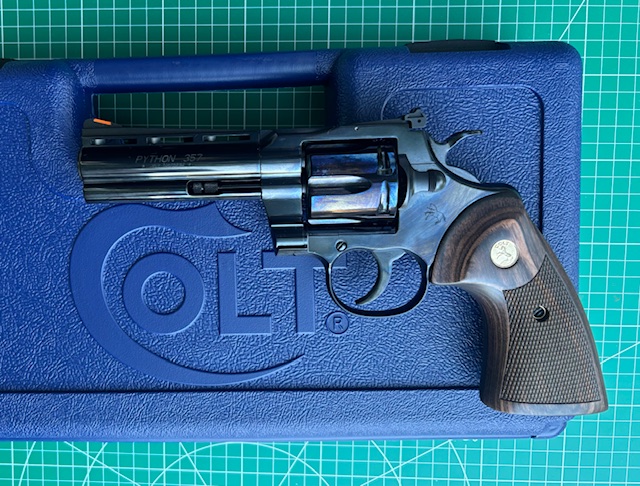
The original Python had that unmistakable Royal Blue luster and collectible appeal that still drives serious money on the secondary market. The new guns don’t quite match that hand-finished old-school charisma, and they’re not cheap—but if you want a Python you can actually shoot a lot, the new one is the clear winner.
Fit and finish on the current production guns is very good, though it doesn’t reach the level of the originals (which cost a lot more back in the day and command even more now). For a serious range gun or duty-capable wheelgun, the new Python gives you far more value.
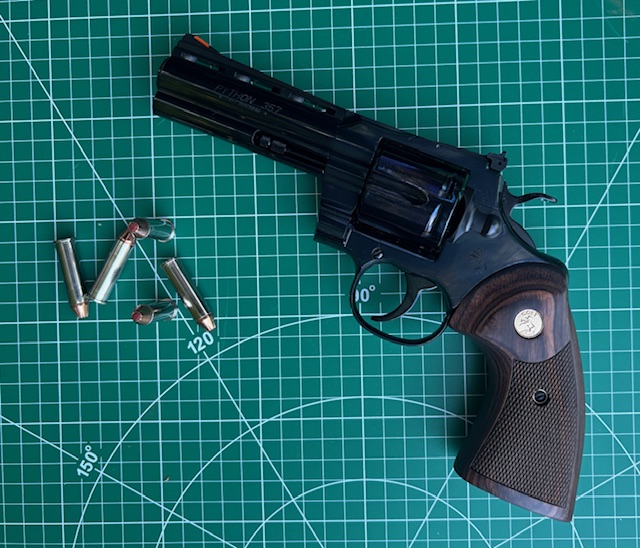
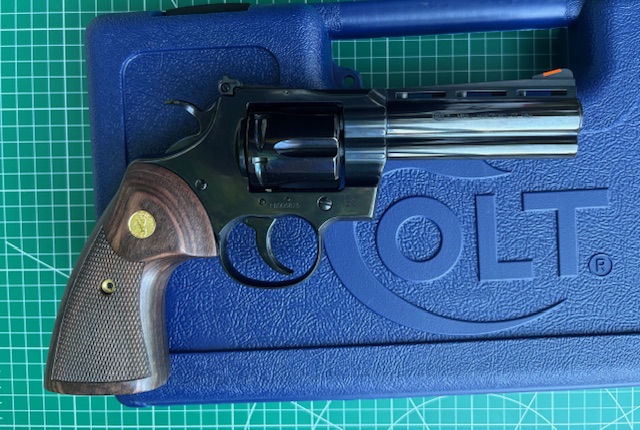
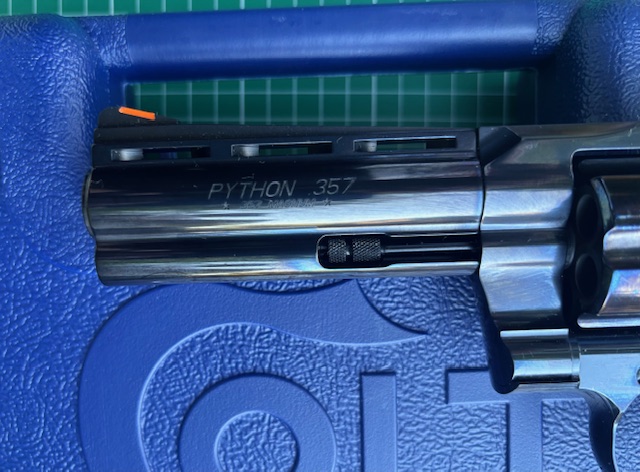
I personally think the 4.25″ polished blued Python is the best-looking of the current lineup. The barrel length is listed as 4.25″ versus the original’s nominal 4″—a minor difference that doesn’t bother me at all. The new guns have three ventilation flutes under the rib on the 4.25″ barrel compared to two on the old ones. Again, not something I lose sleep over.
There is one cosmetic detail I’m not a fan of, and I know I’m not alone: the QR code engraved on the right side of the frame. It just looks out of place on such a handsome revolver. My good friend Tom Taylor, head of marketing at Colt/CZ-USA, explained that it’s a manufacturing QR code for internal use and doesn’t provide any benefit to the end user. I’d love to see Colt relocate it to the bottom of the frame, just in front of the trigger guard. That small change would clean up the looks dramatically.
For the technical upgrades that make this a genuinely better gun—stronger top strap (30% thicker in critical areas), improved metallurgy, reinforced components, better cylinder lockup, and overall durability enhancements designed to handle a steady diet of .357 Magnum—I’ll refer you to the excellent article by Kevin McPherson in American Rifleman titled “The Return of the Blued Python.” Kevin does a great job breaking down exactly why this is a better mouse trap than the original.
Final Thoughts
The Colt Python remains, in my opinion, the most attractive revolver ever made. The reintroduced versions keep that classic snake-gun elegance while delivering the reliability and durability needed for serious shooting. If you’re in the market for a Python to actually put rounds downrange—especially in that sharp-looking 4.25″ blued configuration—the new gun is the one to get.It may not carry quite the same collectible luster as a well-preserved original, but as a shooter, it’s simply the better Python.
Have a good one,
LAV out

Tell us how can we improve this post?
Comments